

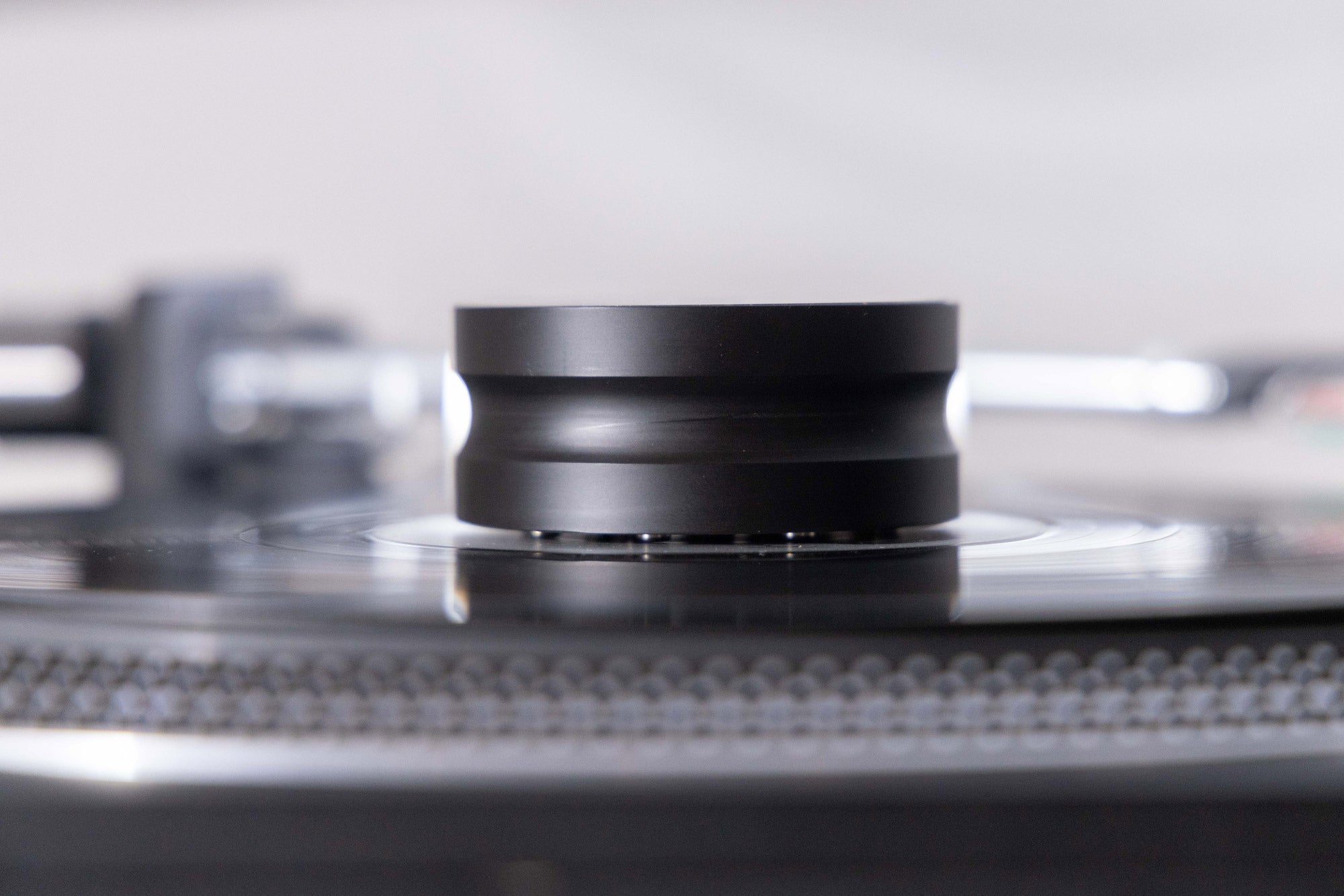
What Do We Mean by “Grounding” a Vinyl Record?
One thing has become clear to us recently.
We probably haven't explained the Record Ground simply enough.
The word grounding can mean different things to different people. In hi-fi, it might suggest electrical earth, static discharge, grounding boxes or even simply controlling vibration and resonance.
That's not what we mean.
The easiest way to explain it is to start with what we're actually trying to achieve.
When a record is playing, the stylus is trying to retrieve an incredibly small amount of information from the groove. At the same time, the record and turntable exist in an environment containing all sorts of unwanted energy and noise.
Our objective with the Record Ground is to give some of that unwanted energy somewhere else to go.
That's why we call it a Ground.
It isn't connected to electrical earth.
It isn't intended simply to press the record harder against the platter.
And it wasn't developed as another clamp, puck or record weight.
Of course, anything weighing 195 grams and sitting on a record will have some mechanical interaction. We don't pretend otherwise.
But that wasn't the question we started with.
The Question We Asked
The question was simply:
Could we reduce unwanted energy at the record surface so that the stylus has an easier job retrieving the information in the groove?
That was the design objective.
The Record Ground uses 16 stainless steel contact points to interface with the record surface, with the intention of providing a controlled path into the Ground itself.
We describe the unwanted energy we're trying to deal with as parasitic energy.
There's no need to think of that as anything mysterious. In simple terms, it means energy that isn't part of the music and isn't helping the replay process.
Our aim is to reduce its influence.
What Should You Hear?
This is actually much easier to explain.
We're not trying to add warmth.
We're not trying to make the bass bigger.
We're not trying to brighten the top end or artificially widen the soundstage.
Ideally, the Record Ground shouldn't add anything at all.
What we're trying to do is reduce something that's getting in the way.
When that happens, listeners have described a lower perceived noise floor, a calmer presentation, greater separation and organisation, more low-level detail, more space around instruments and less of the mechanical character sometimes associated with record replay.
Those aren't instructions about what somebody should hear. They're simply the sorts of observations that have repeatedly come back to us.
One recent Record Ground owner described it particularly well:
“It’s genuinely lowering noise floor to allow a real flourishing of detail.”
After several days of listening, he went further:
“What I do know is that in my setup... it’s taking my TT performance up several notches.”
That's remarkably close to what we set out to achieve.
Why Not Just Call It a Puck?
Because that isn't what we designed.
A conventional puck, clamp or stabiliser generally starts from a mechanical objective. It might couple the record more firmly to the platter, flatten the record, control resonance or add mass.
Those can all be perfectly valid approaches.
We simply started somewhere else.
Our objective was to provide a path for unwanted energy away from the record surface and the stylus/groove interface.
That's why we call it the Record Ground.
Not because the word sounds impressive, but because it describes what we were trying to achieve.
The Same Idea Beyond the Record

The Record Ground isn't the only place we apply this approach.
Our Next Level Grounds take the same basic objective and apply it to equipment casework.
Rather than sitting on a record, they're placed directly onto equipment such as DACs, streamers, amplifiers and power supplies.
Again, they aren't electrically connected to the equipment and we're not referring to electrical earth.
The objective remains the same: to provide unwanted parasitic energy with a controlled path away from where we don't want it.
A set of four Next Level Grounds can be moved around a system very easily. We've found it particularly interesting to experiment with different equipment and different positions, and this ease of deployment is part of what makes them so useful.
Rather than concentrating them all in one place, they can also be distributed throughout a system, allowing the listener to experiment and find where they have the greatest effect.
The Record Ground itself can also be utilised on equipment casework when you're not playing records. It can work to good effect in this application, although that's an additional benefit rather than its primary purpose.
For equipment casework, a dedicated set of four Next Level Grounds is considerably more effective, with their positioning and deployment being an important part of how they're used.
So How Does It Work?
This is perhaps where we've made life difficult for ourselves.
We're happy to explain the design objective.
We're less willing to explain the precise implementation.
The construction and materials behind our Next Level products represent many years of development and remain part of our intellectual property.
Equally, we don't want to fill that gap with impressive-sounding scientific claims that we can't conclusively demonstrate.
So there is a limit to what we're prepared to say.
We appreciate that this can frustrate someone who wants a complete technical explanation before trying the product.
Perhaps we've been too cautious in the past and haven't explained the objective clearly enough.
We're trying to do that better.
You Don't Have to Believe Us
This is probably the most important part.
You don't need to accept our explanation before trying the Record Ground.
In fact, one of the most useful experiences we've had recently came from a listener who was openly sceptical before ordering one.
He already owned and had considerable experience with a number of record pucks, clamps, stabilisers and platter mats. He was quite happy with the combination he'd arrived at and wasn't particularly convinced by what we were saying.
But he was curious enough to try the Record Ground.
Within three records, he was hearing something he hadn't expected.
Several days later, rather than that initial impression disappearing, he reported that the Record Ground continued to show a healthy lead over the alternatives he'd been using.
Interestingly, he also concluded:
“I don't believe it's simply a resonance thing, ie just a weight that ‘happens to make music sound nice’.”
He doesn't claim to know exactly how it's doing what he's hearing.
Neither do we expect him to.
What matters to us is that he listened, compared it carefully in his own system and reached his own conclusion.
He subsequently described several days of playing records with the Record Ground as:
“A totally positive, fascinating experience.”
We'll happily take that.
Hearing Is Believing
Ultimately, we're a small family company making products for people who care deeply about music.
We're not interested in telling somebody what they should hear.
We can explain what we set out to achieve, why we developed the products and how we recommend using them.
After that, the listening has to do the rest.
That's also why we sell directly and offer a 30-day home approval period with free return shipping.
You don't have to take our word for it.
Put the Record Ground on your own turntable, play records you know and make your own mind up.
If it doesn't earn its place in your system, it comes back.
If it does, hopefully you'll spend a little less time thinking about how it works and a little more time enjoying the music.
Hearing is believing.



Leave a comment
This site is protected by hCaptcha and the hCaptcha Privacy Policy and Terms of Service apply.